Sliding Driveway Gate Installation in Encino and the San Fernando Valley
Cantilever or track, matched to what your driveway's grade actually allows.
The right sliding gate depends on one thing: what your driveway does under the gate
A sliding gate moves horizontally instead of swinging into the street or back into the driveway.
That makes it the practical choice for properties with limited turning radius, high traffic volume, or narrow entries. If you are still weighing your options, you can compare sliding and swing gate options to confirm which system fits your property before moving forward.
Iron Man Gates & Fencing installs both track based and cantilever sliding gate systems across Encino and the broader San Fernando Valley, matched to each property's specific grade, surface material, and daily usage pattern. Every installation starts with a site read. Gate selection follows from that, not the other way around.
Valley terrain shapes which system performs long term
A bottom track, the ground level rail along which a standard sliding gate's bottom roller travels, works reliably on flat, clean, paved surfaces. Much of the Valley is not that. Properties in Burbank's foothill neighborhoods, Studio City canyon adjacencies, and the sloped streets above Ventura Boulevard frequently have driveways that drop several inches across the gate's travel path. For those entries, we have detailed gate solutions for sloped and hillside driveways.
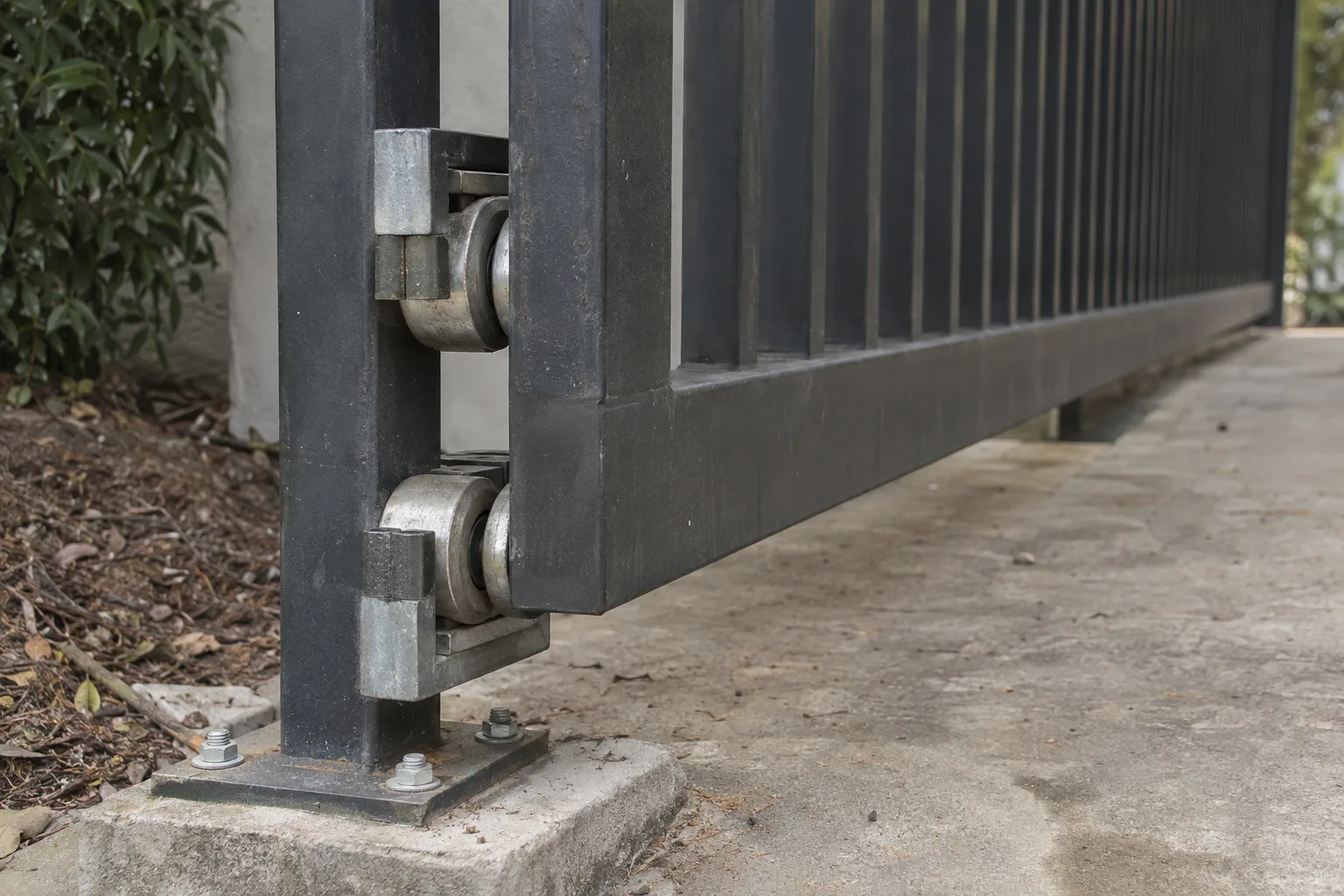
On those entries, a track system collects debris, binds on grade changes, and wears the V groove rollers, the ground contact wheels that guide the gate's travel, faster than the manufacturer's ratings account for.
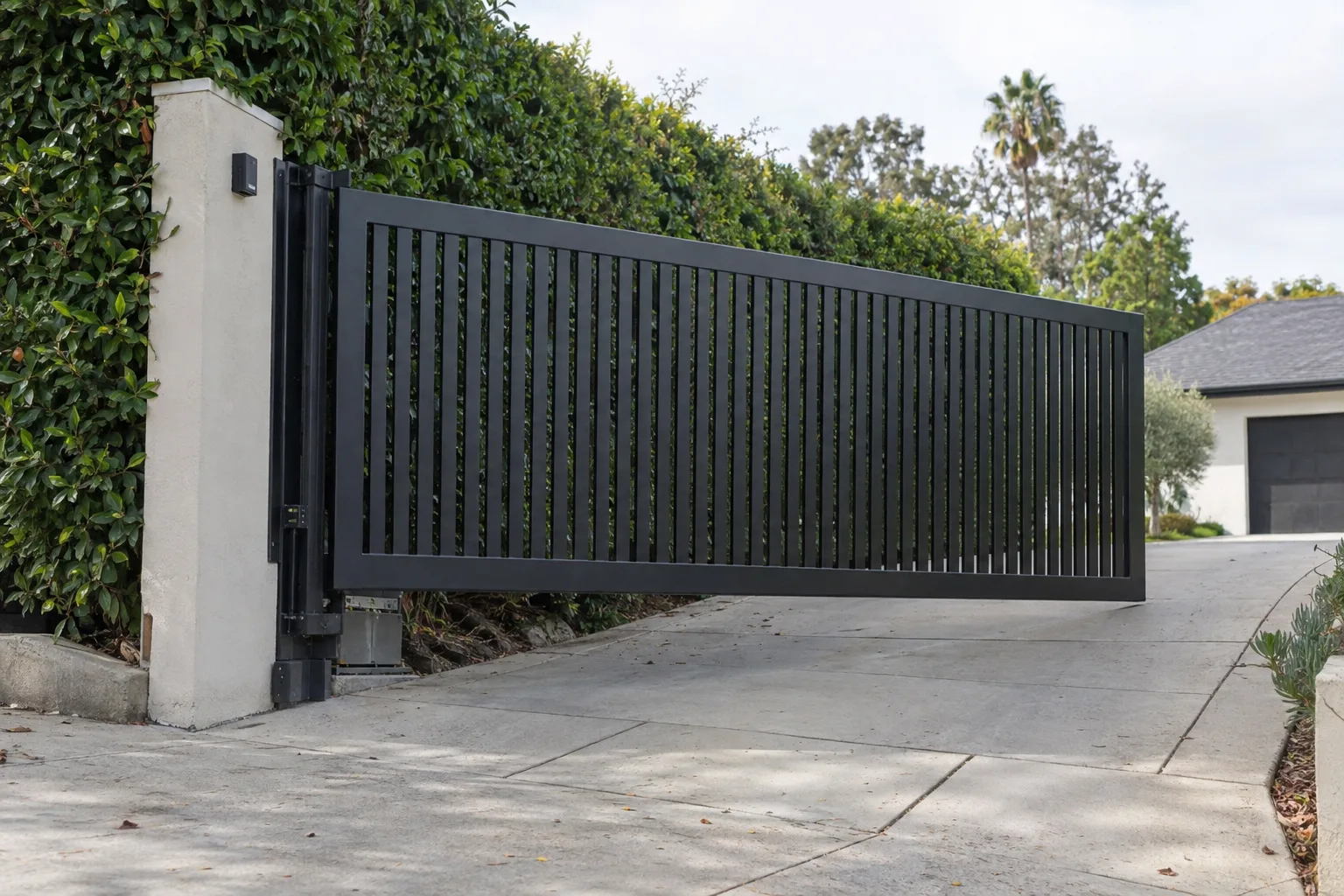
A cantilever sliding gate operates without any bottom track. It is supported by a counterbalanced carriage mounted to one side post, and clears the ground throughout its entire travel. No track, no debris channel, no contact point to bind on a slope.
A cantilever gate needs to extend roughly 30 to 50 percent beyond the hinge post on the counterbalance side, the gate counterbalance, which requires additional clearance along the fence line. That is a real site constraint. We check it before we quote.
Tarzana, off Reseda Boulevard
A sloped entry in Tarzana: what the site visit revealed
Terrain conditions off Reseda Boulevard showed why gate type selection cannot happen over the phone.
The installation took two days. The gate has been running without a service call since.
A property off Reseda Boulevard had a driveway that dropped about four inches from the street to the garage apron. The homeowner had already received quotes for a standard track system, and neither contractor had walked the driveway. We brought a level and a tape measure.
The driveway grade across the gate opening measured about 3 percent, enough to make a bottom track unreliable within a year. Debris collects in the low end of any track on a sloped entry, and once it packs in, the gate binds. The roller hardware takes the stress, and because the gate motor, running on a rack and pinion drive where a toothed rail on the gate meshes with a rotating gear in the motor unit, cannot distinguish between normal resistance and a debris blockage, it works harder until something gives.
A cantilever system on a galvanized steel frame, a zinc coated structural frame under the powder coat finish that handles both mechanical stress and the Valley's heat cycling, was specified instead. The counterbalance clearance on the fence line was tight but workable. The operator carried a duty cycle rating matched to the property's vehicle count, a critical spec for gates that open more than 15 to 20 times daily.
Operator selection is part of the installation, not an afterthought
The right gate motor depends on gate weight, daily cycle count, and power availability at the post.
Sliding gates pair with rack and pinion drive operators in most residential installations. The operator mounts to the primary post and drives the gate's toothed rack horizontally. For heavier custom iron panels, we specify operators with appropriate torque ratings, not undersized units that work at their limit from day one. Our gate opener and motor installation for sliding gates page covers the full scope of operator selection, mounting, and calibration for every gate type we install.
Duty cycle, the percentage of each operating period the motor is rated to run, matters here. A residential gate that opens twice a day needs a different operator than a commercial entry cycling 80 times. We specify the right duty cycle from the start, because an undersized operator fails faster and creates service calls that nobody needs.
Our standards for sliding gate installation
No shortcuts on the structural work, on any job.
Galvanized steel frame
Corrosion protection under the powder coat finish, on all iron gate panels.
Concrete footings
At primary and counterbalance posts, depth matched to post load and local soil conditions.
Dedicated operator mounting
On a steel plate, not directly on the post or pillar face.
Rack alignment
Verified before final motor calibration. Misaligned rack causes premature gear wear.
Safety beams both sides
Photocell installation required for UL 325 compliance on automatic gates.
Full travel test
Torque limit adjustment before project closeout, every time.
Three coats of protective finish on all exposed metal. Not two.
Tell us the driveway grade and gate width, and we will confirm the right system.
Our sliding gate installation process
- 1
Site diagnostics
We measure the full gate opening width, check driveway grade across the gate's travel path, and confirm counterbalance clearance along the fence line. We also verify conduit routing for the operator power supply and identify the location for access control hardware if applicable.
- 2
Installation
Post footings are poured first, and we allow full cure time before gate hardware is mounted. Skipping this step causes post movement during the first season. Gate panels are hung on the carriage rollers, rack is attached and aligned, and the operator is mounted and wired. Access control, keypad, remote receivers, loop detectors, is installed and tested as part of the same visit where possible.
- 3
Post installation testing
We run the gate through a full cycle sequence: open, close, auto reverse on obstruction, and safety beam interrupt. Torque limits and travel limits are set to the gate's actual load. We walk the homeowner through the remote pairing process and leave documentation on the operator model for future service reference.
Sliding gate service area: Encino and the Valley
Dispatching from our Encino office on Ventura Boulevard.
We serve the full San Fernando Valley including Sherman Oaks, Van Nuys, Tarzana, Reseda, Northridge, Woodland Hills, Studio City, Burbank and Glendale. The 405 north and the 134 east give us direct routing to most Valley addresses. We also serve Calabasas, West Hills, Canoga Park, Granada Hills and Chatsworth. For properties that want the full package from the start, we also offer fully automated driveway gate installation that integrates the gate, operator and access control hardware in a single coordinated project.
Can a sliding gate work on my sloped driveway, or do I need a different gate type?
A cantilever sliding gate works on sloped driveways, no bottom track required. Standard track systems bind on grade changes and collect debris in the low end. Cantilever gates ride on side mounted rollers and clear the ground throughout travel. We measure your driveway grade on site before recommending either system. Grade is not guessable from a phone call.
How much does a sliding driveway gate installation cost?
Cost depends on gate width, panel material, operator selection, and whether the site requires a cantilever or track system. Counterbalance clearance requirements can also affect post placement costs. Call 818-399-8524 for a site specific quote.
How long does a sliding gate installation take once I approve the project?
Most residential sliding gate installations complete in two days. Day one covers post footings and concrete pour. Day two covers gate hanging, operator mounting, wiring, and full cycle testing. Hardware is not mounted before footings cure, that step protects against post movement in the first season.
What is the difference between a cantilever sliding gate and a track based sliding gate?
Track based gates ride on a bottom rail, reliable on flat, clean pavement. Cantilever gates have no bottom track and float on side mounted rollers. Cantilever systems cost more but outlast track systems on sloped, uneven, or debris prone driveways. San Fernando Valley terrain frequently favors the cantilever design.
Do I need extra space along my fence line for a cantilever gate?
Yes, cantilever gates require a counterbalance extension of roughly 30 to 50 percent of the gate's span beyond the hinge post. That space must be clear along your fence line. We confirm available clearance during the site visit. If clearance is too tight, we discuss alternative configurations before any work begins.
What happens during the final testing phase before you leave the property?
We run a full open close cycle, test the auto reverse on obstruction, and interrupt the safety beam to confirm it stops the gate. Torque limits and travel limits are calibrated to the gate's actual load, not factory defaults. You leave with remote pairing completed and the operator model documented for future service.
Related gate services
Ready to install a sliding gate? Start here.
Cantilever or track, residential or commercial, across Encino and the San Fernando Valley.
Call us at 818-399-8524 to schedule a site visit. We will assess your driveway grade, confirm gate type, and give you a clear recommendation before any work is scheduled. If you are in the early stages of planning, reviewing what sliding gate installation costs in Los Angeles can help you set a realistic budget before we talk. You can also reach us through the contact form. We respond within one business day.