
Automatic gate won't open or close?
Most gate failures in Los Angeles trace back to five fixable causes: a dead remote battery, a misaligned safety sensor, a failed vehicle loop, an overheated motor, or a tripped limit switch. Here is how to tell them apart before you call.
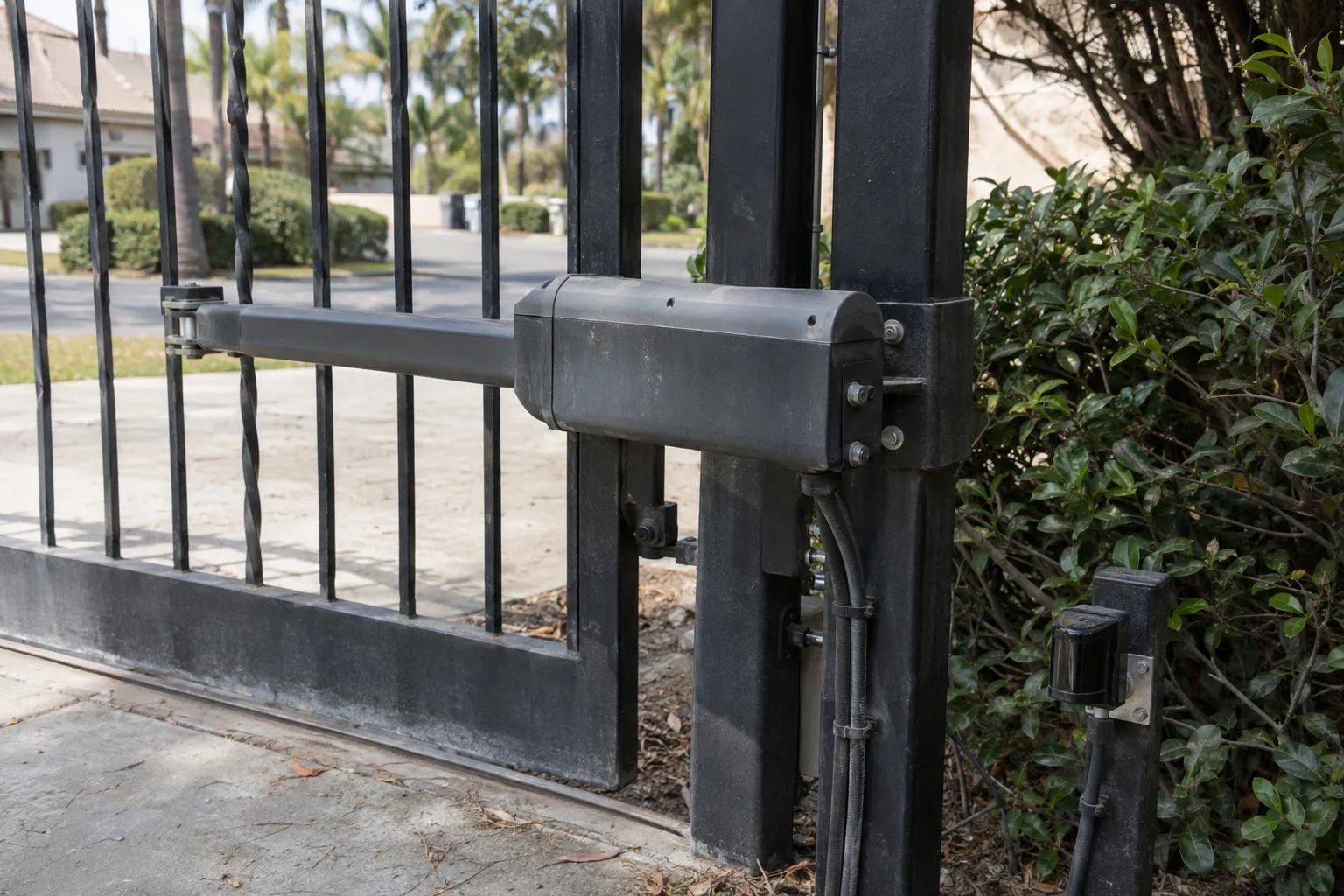
Your gate stopped working. Here's what's actually going on
Most automatic gate failures trace back to five fixable causes.
You've tried the remote twice. You've tried the keypad. Nothing. Before you assume the worst, here's the reality: most gate failures in Los Angeles come down to a dead remote battery, a misaligned safety sensor, a vehicle detection loop failure, an overheated motor, or a tripped limit switch. Each one has a different fix, and not all of them require a service call.
Cause 1
Dead remote battery
Cause 2
Misaligned photocell safety sensor
Cause 3
Failed vehicle detection loop
Cause 4
Overheated motor, thermal cutoff tripped
Cause 5
Tripped limit switch
Why Los Angeles gates fail differently than gates anywhere else
San Fernando Valley heat is hard on gate motors in ways most homeowners never expect.
The San Fernando Valley regularly hits 100°F or higher from July through September. Gate motor housings sit in direct sun, often on dark colored surfaces that absorb even more heat. When that motor reaches a critical internal temperature, a thermal cutoff switch, a safety mechanism inside the operator that shuts the unit down before it burns out, trips automatically.
The gate stops mid cycle or becomes completely unresponsive. The remote does nothing. The keypad does nothing. The motor isn't dead. It's protecting itself.
This is a genuinely common call in Encino, Van Nuys, and Studio City every summer. Generic troubleshooting guides miss it entirely because it almost never happens in cooler climates.
If your gate stopped responding during peak afternoon heat and started working again 20 to 30 minutes later, you likely tripped the thermal cutoff. That might be the end of the story. Or it might mean your motor's ventilation is blocked, its mounting position needs adjustment, or the unit is aging past its thermal tolerance. That distinction matters. If your motor is nearing the end of its service life, it may be worth reviewing your gate opener and motor installation options before the next heatwave forces the issue.
100°F
July through September
A real Encino situation, and what we found
One call. Five minutes of diagnosis. The answer wasn't what anyone expected.
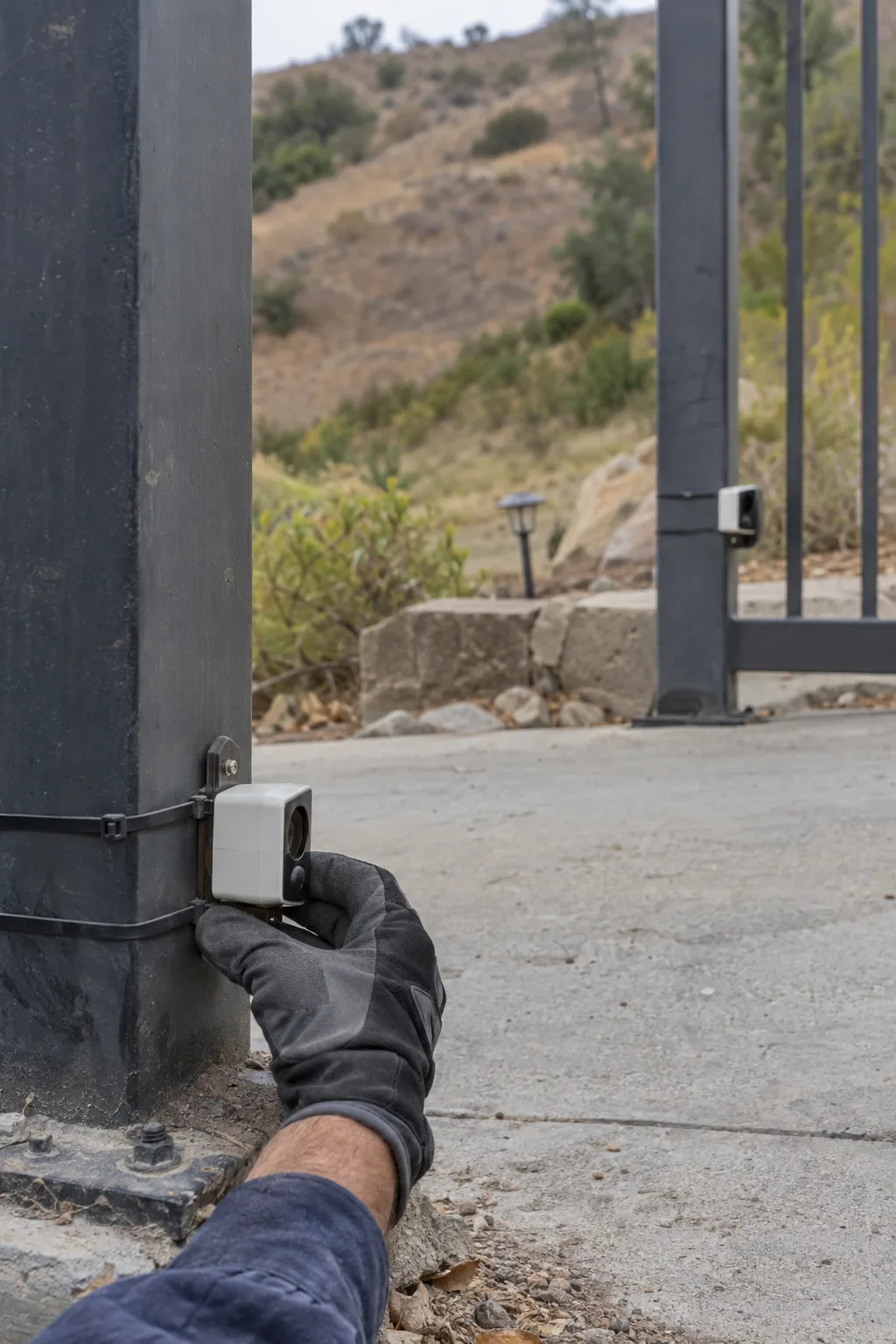
A homeowner in Encino called us in August. Her sliding driveway gate had stopped opening sometime around 2 p.m. She'd replaced the remote battery six months earlier. The keypad wasn't responding either. She assumed the motor had died.
When we arrived, the motor housing was almost too hot to touch. It was mounted in full afternoon sun on a south-facing driveway. The thermal cutoff had tripped. We shaded the unit, let it cool, and it reset. Gate opened fine.
But here's where it got more interesting. During the reset, we noticed the photocell safety beam, the infrared sensor pair mounted across the gate opening that stops the gate from closing on an object, was slightly misaligned. One lens had shifted, probably from a delivery truck brushing against the post. That misalignment meant the gate would stop and reverse every time it tried to close.
Two separate issues. One was heat. One was a sensor. Neither was a dead motor. The repair was a motor shade bracket, a sensor realignment, and a firmware reset, not a motor replacement.
That's why symptom matching matters. What a gate is doing tells you exactly where to look. We dispatched from our Encino office and were on site within the service window we quoted. If your situation sounds similar, our same-week gate repair service in Los Angeles can get a technician out quickly to confirm what you're actually dealing with.
What to check before calling, and when to stop and call anyway
Some gate problems are safe to check yourself. Others need professional tools.
| What the gate is doing | Likely cause |
|---|---|
| Remote shows a weak or flickering signal light | Battery down to partial charge. Swap it before anything else. |
| Gate reverses every time it tries to close | Photocell safety beam knocked off angle or blocked. |
| Motor is trying to run but the gate won't move | Mechanical issue: broken hardware, a track obstruction, or a failed limit switch. |
| Motor is silent and it's been over 30 minutes | Electrical fault beyond a thermal reset window. Needs a technician. |
Start simple. A surprising number of calls come down to a remote battery that's down to 20% charge, just enough to show a signal light, but not enough to reach the motor reliably. Swap in a fresh battery first.
Next, look at your photocell safety beam, the pair of small sensors usually mounted low on each side of the gate frame. If one is physically knocked off angle, you can try realigning it. If the indicator light isn't solid, something is blocking or disrupting the beam. It's worth knowing that photocell alignment and entrapment protection standards for automatic gates are regulated in California by the state's occupational safety authority, which sets requirements for safety sensor performance that apply to residential and commercial installations alike.
Here's where to stop and call. If you hear the motor trying to run but the gate won't move, that's a mechanical issue, broken hardware, a track obstruction, or a failed limit switch (the sensor that tells the operator when the gate has reached fully open or fully closed). Forcing anything at that point risks damage. If the motor is silent and the thermal cutoff reset window has passed, the issue is electrical. Both need a technician with diagnostic tools.
Remote control frequency interference, signal disruption from nearby devices on the same radio band as your gate remote, is another cause that's nearly impossible to diagnose without equipment. It's more common in dense Valley neighborhoods than most people expect. If your keypad and remote are both failing together, that can also point to a deeper issue with your access control and intercom systems rather than the gate operator itself.
How we diagnose a gate that's not responding
Every service call follows the same structured diagnostic sequence.
We carry diagnostic equipment for LiftMaster, FAAC, Viking, and Linear operators. Each brand uses different error code sequences. A code that means obstruction detected on one brand means motor overload on another. Having the right equipment on the truck is what makes that distinction fast and accurate.
A gate operator reset procedure, the manufacturer defined sequence used to clear error codes and restore default operation after a fault, is part of every diagnostic visit, not an afterthought.
- 1
Power verification
Confirm the operator is receiving power, check breakers and transformer output.
- 2
Remote and receiver test
Isolate whether the signal is transmitting and whether the receiver is registering it.
- 3
Safety device check
Test photocell alignment, obstruction sensor function, and pressure edge continuity.
- 4
Loop detector assessment
Test the underground wire coil that senses vehicle presence. A failed loop can prevent opening or hold the gate open indefinitely.
- 5
Motor and limit switch evaluation
Check the operator for thermal faults, error codes, and limit switch calibration.
- 6
Full cycle test
Run the gate through multiple open and close cycles under observation before clearing the call.
If you're still unsure whether your situation calls for a technician or whether there's more to check on your own, our guide on when a professional diagnosis is worth the call walks through exactly that decision.
What actually shapes whether your gate is repaired or replaced
Motor age, fault type, parts availability, and installation quality all factor into the right decision.
Motor age
Most residential gate operators have a service life of 7 to 12 years under normal use. In the San Fernando Valley, where heat cycles are extreme, that range can compress. An older motor with a thermal fault might be repaired this season and fail again next summer.
Fault type
A misaligned photocell is a five-minute fix. A burned-out motor board on a discontinued model is a parts sourcing challenge. Knowing which you're dealing with early changes the conversation.
Parts availability
Some gate operators, particularly older or off-brand units, have components that are difficult to source. This affects both repair timeline and long-term viability.
Installation quality
Gates installed with the motor in an exposed, unventilated position, or without proper concrete footings, tend to generate repeat service calls. Addressing the root installation issue is sometimes the more cost-effective path.
We explain all four factors before any work begins. You know exactly what you're dealing with and why.
Areas we serve in Greater Los Angeles
Iron Man Gates & Fencing dispatches repair crews across the San Fernando Valley and beyond.
From our Encino base at 17200 Ventura Blvd, we serve Sherman Oaks, Van Nuys, Studio City, Burbank, Glendale, Tarzana, Woodland Hills, Reseda, North Hollywood, Calabasas, Santa Monica, Beverly Hills, and dozens of additional communities across Greater Los Angeles. Call us at 818-399-8524 to confirm service availability in your area.
Ready to get your gate working again?
The longer a gate sits in a fault state, the harder it can be on the motor and hardware.
Call us at 818-399-8524 or use our online contact form to describe what your gate is doing. We'll tell you what it likely means, and get someone out to confirm it. You can also browse our common gate and fencing questions we hear most for quick answers before you call.
Frequently asked questions
How much does a gate repair diagnostic visit cost in Los Angeles?
Specific diagnostic visit pricing is not fixed here. Call Iron Man Gates & Fencing at 818-399-8524 for current service call and diagnostic fee information before scheduling a repair visit.
Can a thermal cutoff trip look exactly like a dead motor, and how do you tell them apart?
Yes, a tripped thermal cutoff is nearly identical to a dead motor from the outside. Both cause complete non-response from remotes and keypads. The key difference: a thermal cutoff resets after 20 to 30 minutes of cooling. A dead motor does not. If your gate failed during peak afternoon heat and later worked again, the thermal cutoff is the likely cause, not motor failure.
My gate reverses every time it tries to close. What's causing that?
A blocked or misaligned photocell safety beam causes this exact symptom. The photocell is an infrared sensor pair mounted across the gate opening. When one sensor shifts off angle, the gate reads a phantom obstruction and reverses. Check whether the sensor indicator light is solid. If it's blinking or off, alignment is lost and needs correction.
How long does a gate repair call take from arrival to working gate?
Most single-fault repairs take 45 to 90 minutes on site. Simple fixes, photocell realignment, remote reprogramming, thermal reset, resolve faster. Limit switch calibration or loop detector replacement takes longer. We run a full multi-cycle test before leaving. Complex electrical faults or discontinued parts may require a return visit once components are sourced.
What makes your diagnostic process different from other gate repair companies?
We follow a structured six-step diagnostic sequence on every call: power, signal, safety devices, loop detector, motor, and full cycle test. Other companies often skip to the most expensive likely cause. We also carry brand-specific diagnostic equipment for LiftMaster, FAAC, Viking, and Linear. That means accurate fault identification on the first visit, not trial and error parts replacement.
If my gate motor is older, is repair still worth it, or should I just replace it?
Repair is worth it when the fault is mechanical or limited to a single component. Replacement makes more sense when the motor is over 10 years old, parts are discontinued, or it has failed repeatedly. San Fernando Valley heat compresses motor lifespan compared to cooler climates. We assess age, fault type, parts availability, and installation quality before recommending either path.