
Sloped driveways and hillside lots in Los Angeles: gate solutions that actually work
A gate built for flat ground fails fast on a Studio City canyon street or a Glendale foothills lot. This guide explains which gate systems actually handle slope, and what we check before we spec one.
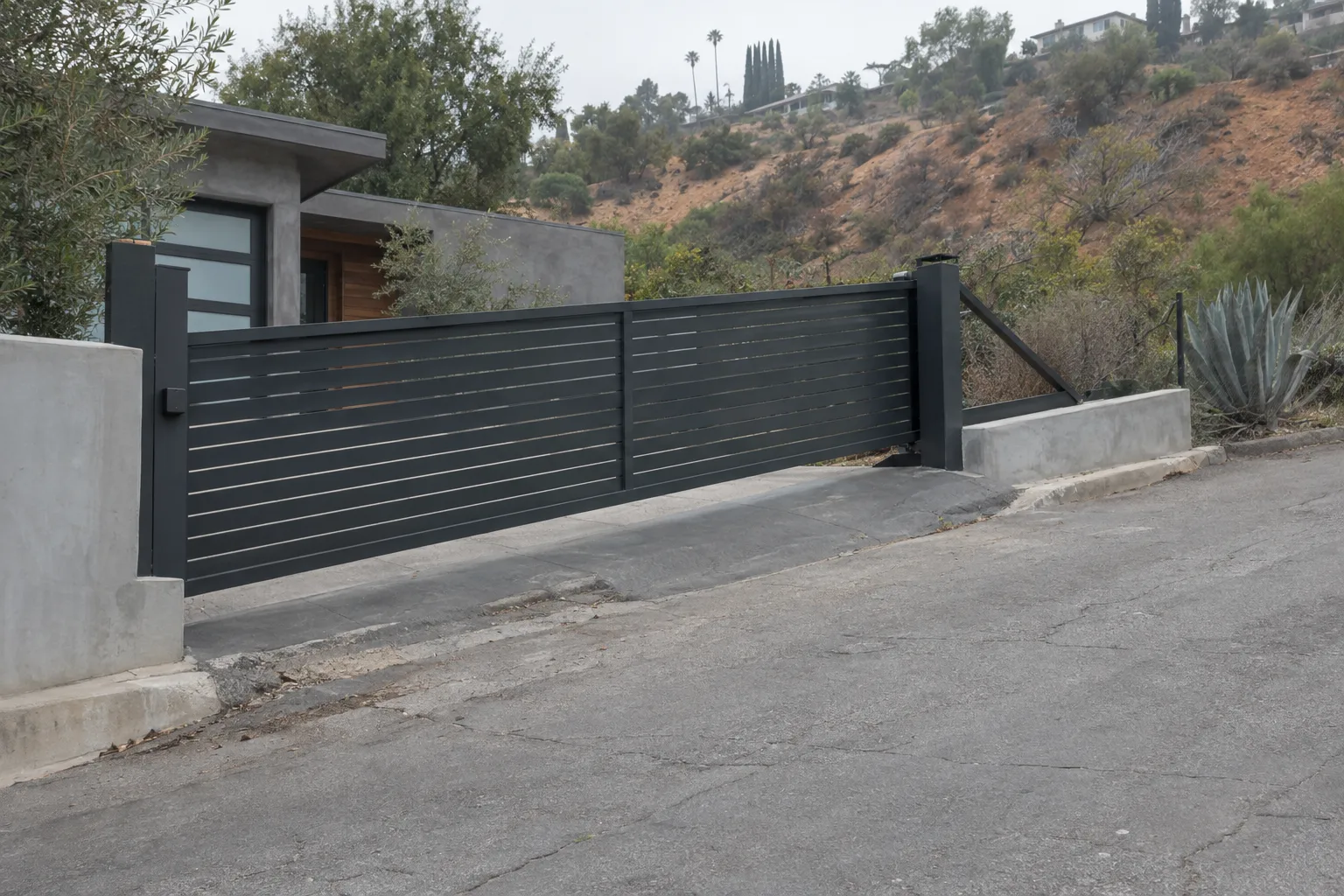
The short answer on sloped driveway gates
The right gate for a hillside lot is not the same gate that works on flat ground.
This is the most important thing to understand before you talk to anyone about gate installation. In Los Angeles, a large percentage of residential properties sit on terrain that slopes, drops or rises between the street and the garage. Studio City, the Glendale foothills, Malibu Canyon, Hollywood Hills. These are not edge cases, they are the norm across large parts of the city. The gate solution has to match the terrain, every time.
Why hillside gate selection matters across Los Angeles
LA's hillside geography makes gate selection a genuine engineering question.
The San Fernando Valley looks flat from the freeway. But the neighborhoods surrounding it, Studio City's canyon streets, the Burbank foothills, the winding driveways off Mulholland, tell a different story. Glendale sits at the base of the Verdugo Mountains. Malibu runs along coastal bluffs. Hollywood Hills driveways can drop 15 to 20 feet from street level to the garage.
Here is what most homeowners do not realize about sloped lots. Driveway grade (the percentage of slope calculated as rise over run) directly controls which gate types are even viable. A grade above roughly 5 to 8 percent eliminates traditional track based sliding gates as a workable option. The bottom track needs a level surface to function. Debris collects in the low end. The gate drags. It jams. It fails.
Iron Man Gates & Fencing operates out of Encino on Ventura Blvd, less than 15 minutes from Studio City and a straight shot to the Glendale foothills. These neighborhoods make up a significant portion of the work we do. Terrain evaluation is not an afterthought, it is the starting point.
Gate options for sloped and hillside properties
Three gate systems actually solve slope problems, and each one fits a different situation.
Cantilever sliding gates
A cantilever sliding gate slides horizontally and is supported entirely from the top rail, with no bottom track and no wheel touching the ground. It is the standard correct answer for sloped driveways. See our cantilever sliding gate installation options for how these systems are configured.
Because nothing touches the ground, grade does not matter. The gate glides on rollers mounted to vertical posts at the side of the driveway. The surface can slope, crack or be covered in gravel, none of that affects gate function.
One trade-off: a cantilever gate requires side clearance equal to the full gate width, plus roughly 50 percent more. A 10 foot gate opening needs about 15 feet of clear space beside the driveway for the gate to slide into. On tight lots, that can be a constraint. Cantilever gates handle the majority of sloped driveway situations we encounter in LA, in Glendale, in Malibu and on Studio City hillside streets.
Swing gates with slope-matched operators
Swing gates, hinged gates that open inward or outward, are sometimes the right answer on sloped driveways, but they need careful configuration.
When a driveway slopes downward away from the gate, a swing gate opens against gravity. That puts constant torque load on the operator. Gate operator torque rating, the measure of rotational force a motor can sustain under load, must be sized up on downslope configurations. Proper motor selection for hillside gate loads is one of the most consequential decisions on a sloped installation. An undersized motor burns out, and on sloped installations that happens faster than most homeowners expect.
The swing arc also needs to clear the slope profile. Measuring the swing arc against actual grade before fabrication prevents the gate bottom from dragging the pavement.
Raked fencing panels for hillside perimeters
Slope does not just affect driveway gates. It affects all the perimeter fencing that runs along canyon lots, tiered yards and hillside property lines.
A raked fencing panel, a panel manufactured with a sloped top rail that follows the hillside contour rather than a level panel installed in a stair-step pattern, is how perimeter fencing handles slope correctly. Stepped panels leave gaps at the bottom as the ground drops. Raked panels follow the terrain.
Raking versus stepping depends on terrain angle, material and look. Wrought iron and aluminum both rake cleanly. Wood panels can be raked but need reinforced framing on steep angles. Unincorporated hillside areas, parts of Malibu Canyon, the foothills and other communities outside city limits, fall under county planning department hillside regulations rather than city jurisdiction, which can affect what is permitted for fencing and gate placement along property lines.
Concrete footings on hillside lots
This part does not get enough attention. Concrete footing depth on sloped terrain is not the same calculation as on flat ground. On a hillside, soil exerts lateral pressure against the post from the upslope side. Erosion on the downslope side can gradually undercut a footing that would hold fine on level ground. Post footings on hillside lots need to be deeper, sometimes wider and poured at angles that account for that lateral load.
Improper footing depth is a common reason gates on hillside lots develop lean or misalignment within a few years. The gate looked fine at installation. By year two, it is pulling toward the slope.
Common hillside gate scenarios in LA
Most hillside gate projects fall into one of three recognizable situations.
Scenario one
The Studio City canyon street
A homeowner on a winding canyon road has a driveway that drops about 12 feet from street level to the garage, poured concrete on a significant grade. A track based sliding gate is not the right fit here, the grade is too steep for a stable track. The right answer is a cantilever sliding gate with a commercial-grade operator. Side clearance along the retaining wall is confirmed before fabrication begins, and the counterbalance weight is calculated based on grade. Installation includes photocell safety beams mounted at post height, not dragged across the sloped pavement where they would never align correctly.
Scenario two
The Glendale foothills corner lot
A property on a side-sloping corner lot has grade running laterally across the driveway, not just front to back. Swing gates would drag on one side as they open, and a cantilever gate needs room the lot does not have on the uphill side. It helps to compare sliding and swing gate trade-offs before settling on an approach. The solution here is a double leaf swing gate with slope-matched operators, each leaf's swing arc calculated independently against the lateral grade, and deeper footings on the downslope side to account for differential soil pressure. This is a project that requires site measurement, not a phone quote.
Scenario three
Malibu coastal bluff perimeter fencing
A property along the coastal bluffs needs perimeter fencing along a tiered backyard that drops in two stages across the rear property line. Raked iron fencing panels, fabricated to match the slope angle of each tier, handle this correctly. Each section is measured on-site, and panels are fabricated to spec, not bent at installation. Post footings are drilled deeper than standard because coastal soil near bluff edges has lower lateral stability. Marine-grade powder coating is specified because salt air off the Pacific accelerates corrosion on standard finishes.
What we look for first on a hillside property
The first thing we check on any hillside job is the grade, before we talk about any product.
On flat Valley lots, gate selection is mostly a conversation about style, material and operator brand. On sloped driveways, the terrain decides the options first. Style comes second.
On a hillside property visit, we measure driveway grade from the street edge to the full depth of the gate opening. We check available side clearance for a cantilever run, confirm whether the soil is compacted fill or native hillside material because that changes footing depth significantly, and walk the perimeter line to understand what raking or stepping approach makes sense for each fence section.
One thing that surprises homeowners is how much operator selection depends on the slope. A residential-grade operator that works perfectly on a flat driveway can overheat and fail within a year on a downslope installation. We size the motor to the actual torque demand, not to the gate width alone.
We also check for signs of soil movement. In canyon neighborhoods and on hillside lots throughout the Valley, soil shifts after rain, after seismic events and after years of dry-season settling. If a previous gate post has started to lean, that tells us the footing was not sized for the lateral pressure at that location. Correcting that before hanging a new gate is part of the process, otherwise the same issue returns in a couple of years.
Sloped lot installations also frequently trigger additional city review, and understanding grading and structural requirements before a project begins avoids costly delays.
The goal is a gate that functions correctly on day one and still functions correctly five years later.
Iron Man Gates & Fencing, Encino
When a hillside gate project needs a pro
Some aspects of a sloped terrain gate project you can assess yourself, and some require a site visit.
You can get a reasonable sense of your driveway grade by measuring the rise and run yourself. A 12 inch drop across a 10 foot horizontal run is a 10 percent grade, firmly in cantilever territory. That alone tells you a track based sliding gate is off the table.
Footing specification is a different matter. Hillside soil varies enormously across LA: sandy fill in some canyon developments, dense clay in the Glendale foothills, unstable bluff-edge material in coastal neighborhoods. Footing depth and diameter need to match actual soil conditions.
Operator torque requirements also cannot be confirmed without knowing the exact gate weight and swing load at your grade angle. An undersized operator on a sloped installation creates a problem that shows up slowly: shortened motor life, inconsistent opening, eventual failure.
It is also worth reviewing our permit requirements for hillside gate projects early in the process, as sloped lot installations often trigger additional city review that flat lot projects do not face.
Call a pro when your driveway has any visible grade, when your lot is tiered or canyon-adjacent, when a previous gate has leaned or gone out of alignment, or when the swing arc of a gate would need to clear a sloped surface. A site visit is the only reliable way to get this right.
Areas we serve
Iron Man Gates & Fencing serves hillside and sloped lot properties across the Greater Los Angeles area, including Studio City, Glendale, Burbank, Hollywood Hills, Malibu, Sherman Oaks, Encino, Tarzana, Woodland Hills, West Hills, Calabasas, Chatsworth, Granada Hills, Northridge, Beverly Hills, Pasadena and throughout the San Fernando Valley.
Get the right gate for your terrain
The first step is a conversation about your actual driveway, not a product catalog.
If your property has any slope, grade or hillside terrain, bring that up first. It shapes every decision that follows. Iron Man Gates & Fencing specializes in automatic gate installation for Los Angeles properties, including hillside and canyon terrain across Greater Los Angeles, and terrain evaluation is part of how every project starts.
Call us at 818-399-8524 or reach out through our contact page. Tell us about your driveway and your lot, and we will help you find the gate solution that fits your specific terrain, not just your style preference.
Frequently asked questions
Does driveway grade actually change which gate types I can get, or is that just a sales tactic?
Grade is a mechanical constraint, not a sales angle. A slope above roughly 5 to 8 percent eliminates track based sliding gates entirely. Debris collects at the low end, the gate drags, and failures follow. Cantilever gates and properly torque-rated swing gates are the two engineered solutions for sloped terrain. Iron Man Gates & Fencing evaluates grade before any product is discussed.
What does a hillside gate installation cost compared to a standard flat lot project?
Sloped installations cost more than flat lot jobs due to deeper footings, higher torque operators and custom fabrication requirements. Specific pricing requires a site visit and measurement. What is clear: cantilever gate hardware, slope-matched operator sizing and engineered footing specs all add to the base price. Getting a site measurement first prevents the more expensive mistake of installing the wrong gate type entirely.
How long does a hillside gate project take from site visit to working gate?
Most hillside gate installations complete within one to two weeks of the site visit. Custom raked panel fabrication or estate-scale perimeter fencing adds time. Sloped lots always require an in-person measurement before any timeline is confirmed, since phone quotes on hillside properties skip the step that determines whether the product will actually work.
Why would a cantilever gate cost more than a regular sliding gate?
Cantilever gates require a longer track post system and a counterbalance section equal to roughly 50 percent of the gate width. That additional material and engineering drives the price up. On a sloped driveway, the cantilever's trackless design is not optional, it is the only sliding gate configuration that functions correctly without a level ground surface underneath.
My previous gate on this sloped lot lasted two years before it started dragging. How is this different?
Drag on a sloped lot almost always means the wrong gate type was installed, the footings were undersized for lateral soil pressure, or both. Iron Man Gates & Fencing measures driveway grade and soil conditions before selecting a gate type or operator. Footing depth on hillside lots is calculated differently than on flat ground, and that difference is what separates a gate that holds alignment from one that fails within a few seasons.
Can you give me a firm quote for a hillside gate without coming to my property first?
No accurate quote is possible without a site visit on a sloped lot. Grade angle, available cantilever clearance, soil type and swing arc geometry all vary property by property across Los Angeles hillside neighborhoods. A phone quote on a hillside installation skips the measurements that determine which gate types are even viable, and sets up a mismatch between what was promised and what can actually be built.