Sliding gate or swing gate: which one works for your Los Angeles driveway
Slope, side room and swing clearance decide which gate type your driveway can actually support. We measure the property first and recommend second.
Your driveway grade settles this faster than anything else
A swing gate needs flat ground through its full arc of travel: from closed to fully open. That arc equals the full width of the gate leaf.
On a driveway that rises from the street, the leaf hits the ground before it finishes opening. Sometimes it cannot open at all. Even a modest 5% slope, barely noticeable on foot, can create clearance problems for a 10 foot swing gate leaf. In the San Fernando Valley, where tract era lots were graded decades ago and hillside properties in Studio City and Burbank involve real elevation change, swing gate failure is a real outcome when no one measures first.
Driveway grade, the slope angle expressed as a percentage, is the single variable we measure on site before any recommendation is made. What the property can support drives the decision, and preference comes second.
Gate solutions for sloped and hillside lots| Factor | Swing gate | Sliding gate |
|---|---|---|
| Driveway grade | Needs flat ground through the full arc | Travels sideways, unaffected by slope |
| Space needed | Setback of 18 to 20 feet from the curb | Lateral run about 1.5 times gate width |
| Operators | Two synchronized motors on double leaf | One operator for the full gate |
The San Fernando Valley produces nearly every slope condition there is
Encino to Thousand Oaks covers flat valley floors, canyon edge terrain and everything between.
Properties in Reseda and Lake Balboa sit on relatively flat pads, so swing gates are generally viable there. Move into the foothills above Burbank or up into the canyons near Chatsworth and Simi Valley, and the terrain shifts. Driveways there can run at 15% to 20% grade. A swing gate on a 20% slope contacts the pavement before it clears 45 degrees of travel.
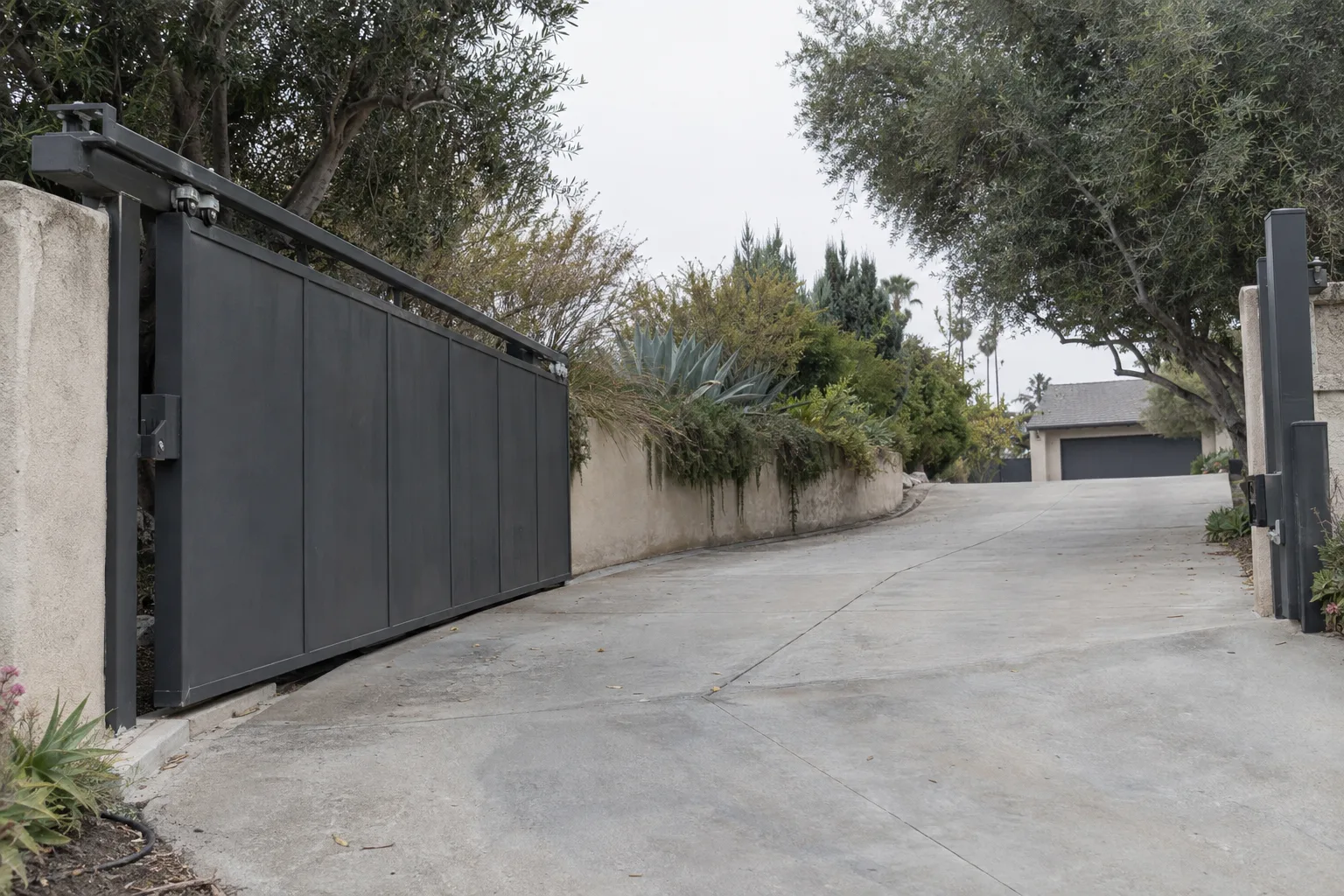
Sliding gates travel horizontally along a track parallel to the property line and do not interact with grade the same way. That is why cantilever sliding gates, which operate without a bottom track, have become the standard solution across hillside and sloped Los Angeles properties. See sliding driveway gate installation in the San Fernando Valley for the approach we use when grade rules out a swing configuration.
Iron Man Gates & Fencing operates out of Encino and serves properties from the Hollywood Hills to Thousand Oaks, a corridor that includes nearly every slope configuration this market produces.
A Tarzana driveway where the grade changed the plan
A homeowner wanted a classic double leaf swing gate on a newer Spanish colonial build. Visually it made sense. Mechanically, the math did not close.
- 1
Step 1
The measurement
The driveway grade measured 11%. The proposed gate width was 14 feet total, seven feet per leaf. At 11% grade, a seven foot leaf loses roughly nine inches of clearance before reaching 90 degrees of travel. Not enough room to clear without the gate dragging the driveway surface.
- 2
Step 2
The two options
One path was a modified swing gate with shorter leaves and a stepped pillar design: workable, but a real visual compromise from the original plan. The other was a cantilever sliding gate with a custom wrought iron panel matched to the home's architectural detail.
- 3
Step 3
The result
The homeowner chose the cantilever slide. The gate travels along a rack mounted above grade: no bottom track, no clearance problem. Swing arc clearance was no longer a constraint. The on-site measurement conversation takes roughly 20 minutes, and it changed the outcome on this property.
Setback requirements add another layer to the swing gate decision
Swing gates in most Los Angeles jurisdictions must sit back from the street, and that setback shapes the whole driveway layout.
Setback requirement is the minimum distance between the gate's closed position and the public right of way. Most LA area cities require enough room for a vehicle to clear the street completely while the gate opens, typically 18 to 20 feet back from the sidewalk or curb line. Confirm exact dimensional standards with the local building department before installation begins.
On short or shallow driveways, that setback reduces usable space. The gate ends up close to the garage, leaving little room for vehicles to stage while it opens. Sliding gates do not require the same lateral clearance into the driveway, since the gate travels parallel to the fence line.
Dual operator synchronization
Coordinating two independent swing gate motors to open at identical speed and timing. When synchronization drifts, gates collide or fail mid-cycle. Sliding gates with a single operator avoid this entirely.
None of this rules out swing gates. On a flat, deep driveway with adequate setback, a double leaf swing gate is a legitimate and often striking choice. See single and double leaf swing gate installation for that path. The decision has to start with actual site conditions.
What goes into an installation that holds up
Gate type is one variable. Material, operator rating and foundation determine long term performance.
- On-site grade and clearance measurement before any gate type is confirmed
- Operator sizing matched to gate weight, since undersized motors fail early on heavy custom iron panels
- Single-phase motor selection appropriate to the residential power at the property
- Concrete footing depth sized to soil type, since Valley clay behaves differently than coastal sandy soil
- Safety beam and loop detector integration on every automatic installation
- Powder coat finish rated for San Fernando Valley UV and heat exposure
Racking compatibility, the ability of a gate panel to follow a slope, is confirmed before fabrication on any hillside installation. A panel built for a flat installation cannot be field-adjusted to follow grade afterward.
Six variables shape the outcome, and four are about the property
Not the catalog. Not what the neighbor installed.
Driveway grade
The first filter. Above roughly 8% grade, swing gates require careful engineering or become impractical.
Lateral clearance
Sliding gates need open space alongside the driveway, typically 1.5 times the gate width, for the panel to travel into. A wall or hedge on that side can block the path.
Gate travel speed
High-use driveways with frequent deliveries or multiple drivers benefit from faster cycle times. Sliding cantilever gates generally travel faster than swing gates of the same width.
Driveway depth and setback
Shorter driveways favor sliding configurations, since setback eats into usable space for a swing arc.
Architectural style
Spanish colonial and Mediterranean homes in Encino, Tarzana and Calabasas suit wrought iron scroll work on either gate type. Mid century modern homes in Studio City and Burbank often suit cleaner horizontal sliding designs.
Operator budget
Dual operator synchronization for a double leaf swing gate adds cost. A single sliding operator is a simpler mechanical system. See operator and motor costs for each gate type before finalizing a configuration.
Areas we serve
Iron Man Gates & Fencing serves properties throughout the San Fernando Valley and across Greater Los Angeles, including Encino, Sherman Oaks, Tarzana, Studio City, Burbank, Glendale, Woodland Hills, Calabasas, West Hills, Chatsworth and Northridge. We also reach Beverly Hills, West Hollywood, Santa Monica and communities across the South Bay, Pasadena and the Conejo Valley.
The right gate type starts with a conversation about your actual driveway
Grade, depth, clearance and setback determine which gate works, not the catalog and not what the neighbor installed.
We measure first and recommend second. That sequence prevents change orders, delays and gate types that cannot complete a full cycle.
Call 818-399-8524 to schedule an on-site assessment. Bring the questions you have been working through and we will answer them against the actual property.
Frequently asked questions
How do you determine whether my driveway can support a swing gate before anything is ordered?
We measure your driveway grade on site before recommending a gate type. A slope above roughly 8% often eliminates swing gates entirely, since the leaf contacts the pavement before completing its arc. That measurement prevents the most common and costly mistake in gate selection. Driveway grade is the physical constraint that drives the recommendation, not the catalog.
Does a sloped Los Angeles driveway always mean I have to get a sliding gate?
No. Slope above 8% rules out most swing configurations, but lateral clearance determines whether sliding works. A cantilever sliding gate needs open run space equal to roughly 1.5 times the gate width alongside the fence line. If a wall, hedge or structure blocks that path, neither type is automatic. We evaluate both constraints on the same site visit.
What does an on-site gate type assessment cost, and how long does it take?
The on-site measurement conversation typically takes about 20 minutes once we are at the property. For pricing on the assessment visit, call Iron Man Gates & Fencing directly at 818-399-8524.
If I want a double-leaf swing gate but my grade is borderline, what are my actual options?
Two options exist: shorter gate leaves with a stepped pillar design, or a cantilever sliding gate fabricated to match your home's architectural style. The sliding option delivers the same ironwork without the clearance problem. We present both at the site visit so you decide with full information.
What makes your gate type recommendation different from what most companies offer?
Most companies ask what you want and quote it. We measure your driveway grade, lateral clearance, setback distance and available swing arc before naming a gate type. A recommendation built on site measurements eliminates change orders caused by gates that physically cannot complete a full cycle on your actual property.
Does the gate type decision change what operator and motor I need?
Yes. A double-leaf swing gate requires two synchronized operators. A single cantilever sliding gate uses one. Dual operator synchronization adds cost and one more mechanical component that requires calibration. Operator selection is confirmed after gate type is locked in, so the motor spec always matches the mechanical load and configuration of the final installation.