Fencing and gates in LA's wildfire zones
What changes when your property sits in a High Fire Hazard Severity Zone: material choice, defensible space, permits and what post-fire replacement actually involves.
The zone your property sits in changes what materials make sense
If CAL FIRE has designated your neighborhood a High Fire Hazard Severity Zone (HFHSZ), your fencing decisions carry consequences beyond curb appeal.
Material choice affects how quickly fire can travel your perimeter. It affects whether your insurance adjuster cooperates after a loss. In some cases it affects what the building department will approve when you rebuild. This page answers the practical questions, in plain terms.
Why this is specifically a Los Angeles problem
Greater LA has one of the largest concentrations of HFHSZ-designated residential properties in the country.
Chatsworth, Granada Hills, Northridge, Simi Valley, Malibu: these are not abstract fire risk statistics. These are neighborhoods where homeowners have lived on the same street for decades, then watched brush move in from the hills during a dry October wind event.
A significant portion of those communities falls within what is called the Wildland-Urban Interface, or WUI: the zone where developed residential property meets undeveloped wildland vegetation. CAL FIRE maps these zones across the state, and a large share of the San Fernando Valley's northern foothill communities sit squarely inside them.
Here is what most homeowners do not realize about WUI designations: your fence sits on that interface. A wood fence running along your back property line is not just decorative. During a fire event, it can function as a fuel path directly toward your structure.
That is a documented fire behavior pattern that emergency responders and insurance adjusters both understand. The material you choose matters in a way that it simply does not in Culver City or Burbank flatlands.
Materials, codes and what replacement actually involves
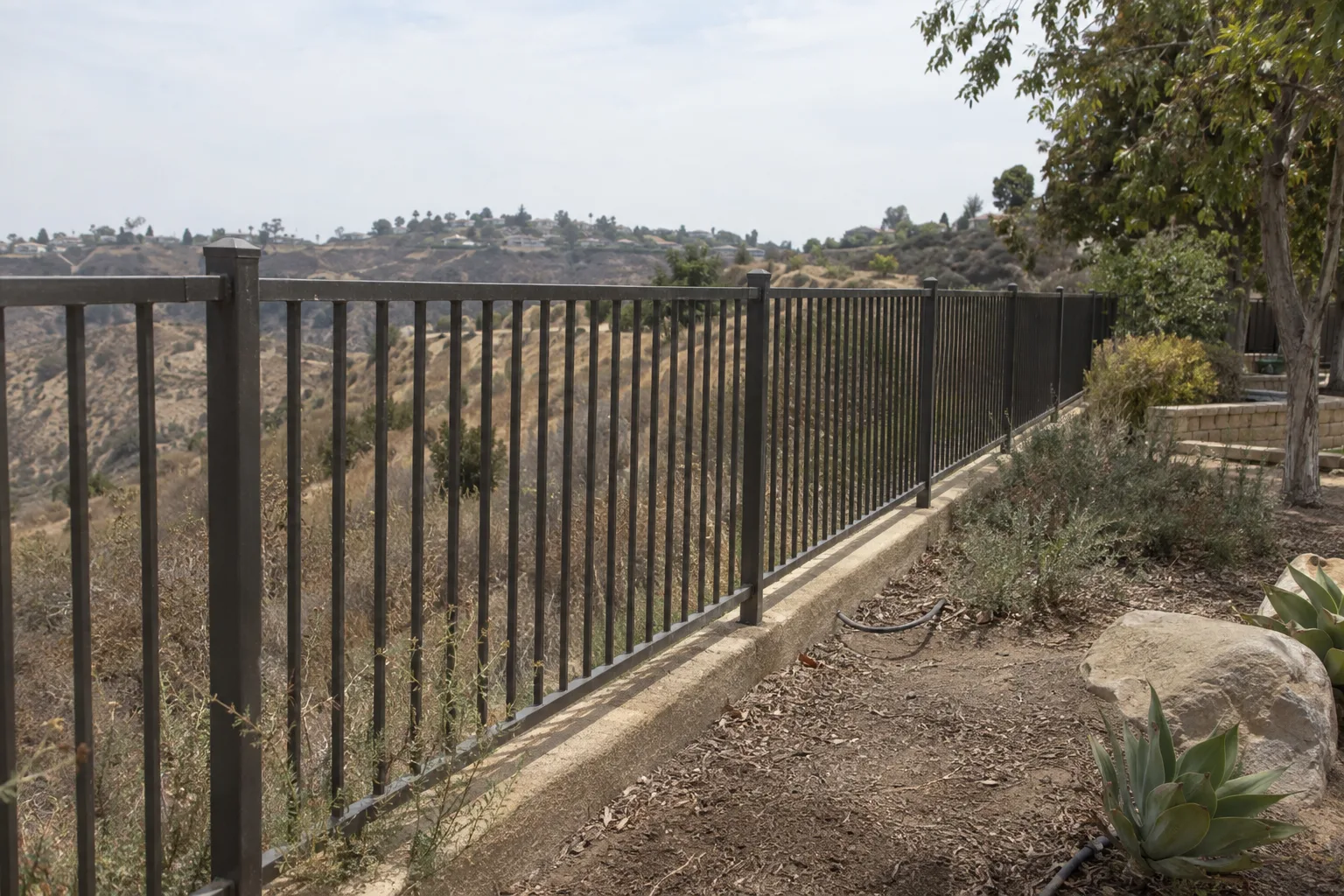
Non-combustible fencing means iron, steel or aluminum. Period.
| Material | Fire hazard classification |
|---|---|
| Iron, steel, aluminum | Non-combustible, carries no fuel load |
| Wood, vinyl, PVC, most composite | Combustible, can act as a fuel path toward the structure |
What "non-combustible" actually means
This is not a marketing claim. It is a material science designation with real regulatory weight. California Fire Code Chapter 49, the section governing fire safety requirements in high hazard areas, addresses material standards for construction and replacement work in designated zones. When you are rebuilding after a fire event, or installing new fencing on a property in an HFHSZ, Chapter 49 is the framework your local building department references. For a full breakdown of what each city requires, see our gate and fence permit guide.
Aluminum fencing is worth understanding here. It will not rust under coastal salt air, will not warp in 105 degree Valley heat, and will not contribute fuel load along your fence line. For Malibu and Westside properties dealing with both fire risk and marine air, aluminum fencing options are a genuinely practical choice, not just an upgrade.
Defensible space and where your fence sits in it
California Public Resources Code section 4291, the defensible space law, requires property owners to maintain clearance zones of 30 feet and 100 feet around structures. This is what most people know as the brush clearance requirement.
What fewer people know: fencing material within those zones affects your compliance posture. A wood fence running through Zone 1 (0 to 30 feet from the structure) is combustible material sitting inside your defensible space buffer. That is a conversation worth having with your local fire department before you reinstall the same cedar board on board you had before the fire.
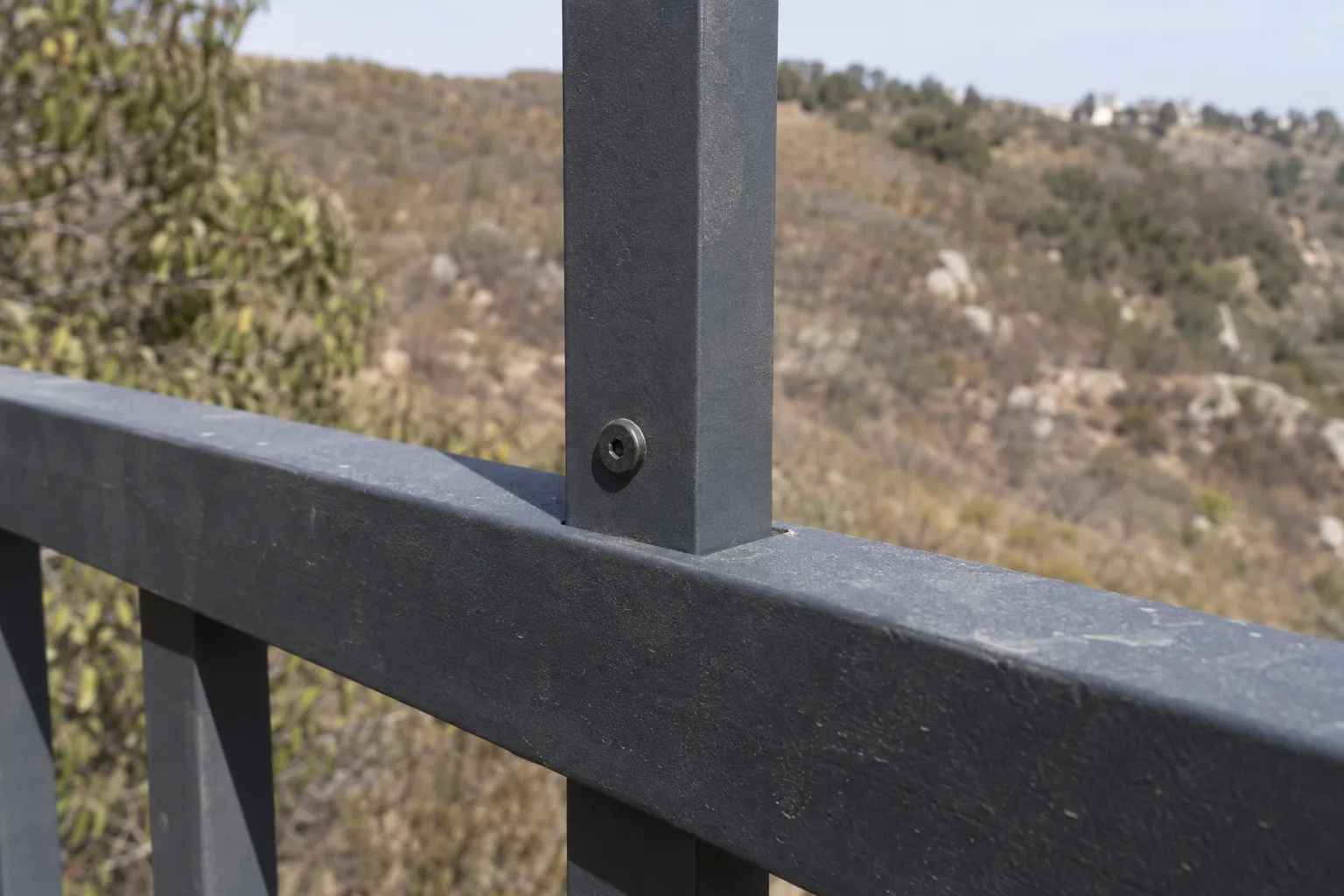
Iron and steel fencing carries no fuel load. It can sit in Zone 1 without contributing to fire spread calculations. For properties in WUI-designated foothill communities in the San Fernando Valley, our gate solutions for hillside and foothill lots address the additional terrain challenges these sites present.
The post-fire replacement process
Replacing fencing after a wildfire is not the same as a standard installation job. Several additional steps apply.
- 1
Debris clearance comes first
Before a building department will issue a permit for new fence installation on a fire-affected property, local jurisdictions typically require documentation that debris has been cleared. In some cases soil testing may also be required, affecting your timeline by weeks.
- 2
Permit requirements remain in place
In the City of Los Angeles and in most incorporated cities across LA County, fencing over certain heights requires a permit. That applies to replacing fire-damaged material just as it does to new installation, and fire-damaged properties often receive heightened code compliance scrutiny.
- 3
Your material choice may need to meet current code
If local codes have been updated since your original fence was installed, and in many fire-zone communities they have, you may not be able to replicate your previous fence exactly. Confirming what current code allows before committing to a material saves significant rework.
Three situations that come up repeatedly
How this plays out for real property owners in Greater Los Angeles.
Post-fire replacement in Chatsworth
A property owner loses a 200 foot cedar wood fence along their rear and side property lines during a brush fire. The house survives, the fence does not. When they call for replacement, the debris clearance is not complete, the insurance adjuster is asking for pre-loss documentation they do not have, and the replacement material question comes up: wood again, or a switch to iron or aluminum?
Switching to aluminum or wrought iron fencing serves three purposes here. It satisfies current fire-zone material guidance from the building department, it eliminates the fuel path the original fence created, and it gives the adjuster a defensible, documented material upgrade to work with. Timeline on a project like this typically runs longer than a standard installation, with debris clearance delays factored in.
Proactive upgrade in Granada Hills
A homeowner decides, before any fire event, to replace aging wood fencing with wrought iron. The primary motivation is aesthetics, but the property is in an HFHSZ and the existing fence runs along a hillside lot adjacent to a brush-covered slope. This is the ideal scenario: no insurance documentation pressure, no debris clearance requirements, no rushed timeline. The homeowner chooses materials proactively and the result is a perimeter that performs better in everyday and fire-adjacent conditions alike.
The insurance documentation gap in Malibu
A property owner files a fire damage claim. The adjuster requests pre-loss documentation: photos of the original fence, a description of materials, and a contractor estimate for replacement. They do not have pre-loss photos, do not know what species of wood was used, and the original installer is no longer in business.
This gap is extremely common. The practical step: take dated photos of your fence from multiple angles and keep them in a cloud folder labeled with your address. Note the material and approximate linear footage. It takes 15 minutes and can be the difference between a smooth claim and a disputed one.
A direct take from the field
Property owners in Chatsworth and Granada Hills often call us after a fire scare, not after actual damage, finally ready to have the material conversation they had been putting off. The question is almost always the same: is iron actually worth it, or is that just a sales pitch?
The answer is straightforward. Iron and steel do not burn. Wood and vinyl do. In a WUI community where fire moves along fencing before it reaches structures, that difference is real. It is not about fear, it is about understanding what you are actually buying.
If your fence runs along a hillside, a brush-adjacent lot, or the back of a property that backs up to open land, non-combustible material is the right call. If your fence runs along a flat interior yard in a fully developed neighborhood with 30 feet of concrete on all sides, the risk calculation is different.
Location within the property, slope and adjacency to vegetation all affect the answer. That is why we look at the actual site before recommending a material. A blanket prescription for every property in a fire zone would be wrong, and we do not do that.
Iron Man Gates & Fencing, Encino
When it makes sense to call a professional
A site visit answers questions that a map designation cannot.
CAL FIRE's HFHSZ maps are publicly available. You can look up your parcel and confirm your designation in about five minutes online. That tells you what zone you are in. It does not tell you how your specific fence line relates to your defensible space zones, what your local building department requires for replacement permits, or which materials suit your terrain and adjacency conditions. Those answers come from someone standing on the property.
A professional consultation is the right next step if any of the following apply:
- You are replacing fire-damaged fencing and working through an insurance claim
- Your property backs up to a hillside, canyon or undeveloped brush land
- You are in Chatsworth, Granada Hills, Malibu, Simi Valley or another designated HFHSZ community
- You are unsure whether your current fencing material is appropriate for your zone
- You are planning a new gate or perimeter fence install and want material guidance tied to actual code
A site visit gives you a real answer. It also gives you the documentation baseline (photos, material specs, linear footage) that insurance adjusters ask for, before you ever need it.
Areas we serve
Iron Man Gates & Fencing serves fire-zone communities across Greater Los Angeles.
We work regularly in Chatsworth, Granada Hills, Northridge, Simi Valley, Malibu, Calabasas, West Hills and Canoga Park, all communities with significant HFHSZ-designated parcels. We also serve Sherman Oaks, Encino, Tarzana, Woodland Hills, Studio City, Burbank, Glendale, Santa Monica, and communities across the broader San Fernando Valley and Los Angeles Basin.
The right starting point is a conversation about your property
If you are in an HFHSZ community and have questions about fencing material, replacement after fire damage, or what a non-combustible perimeter looks like at your property line, call us directly.
We serve fire-zone communities throughout Greater Los Angeles from our Encino office at 17200 Ventura Blvd, Suite 301A. You can also reach us through the contact form. Let us know your neighborhood, your current fence type and what prompted your question. We will give you a straight answer.
Frequently asked questions
Does my fencing material actually change my wildfire insurance claim outcome?
Yes. Material documentation directly affects adjuster decisions. Adjusters evaluate pre-loss materials when calculating replacement value. Iron and steel fencing is classified as non-combustible, which supports stronger claim positions than wood or vinyl. Properties in Chatsworth, Granada Hills and Malibu face this scenario regularly. Keeping dated photos and material specs in a cloud folder, before any fire event, is the single most practical step you can take right now.
How long does post-fire fence replacement take compared to a standard installation?
Post-fire replacement typically runs longer than a standard job. Debris clearance must be documented before permits are issued. Soil testing may be required in areas where toxic materials burned. Permit review can add additional weeks on top of that. Realistic planning means accounting for these steps upfront, not discovering them after a materials order is already placed.
Why would I switch from wood to iron fencing if my house survived the last fire?
A surviving structure does not mean the fence performed well, it means the fire stopped in time. Wood fencing functions as a fuel path that moves fire toward your structure. Iron and steel carry no fuel load, so switching eliminates that path entirely. It also satisfies current building department material guidance in most high fire hazard severity zone communities, which matters when you pull a replacement permit.
Do I need a permit to replace fire-damaged fencing, or does disaster status waive that?
Permits are still required for fence replacement after wildfire damage. Disaster declarations do not waive permitting in most LA area jurisdictions. In some cases, fire-affected properties receive heightened code compliance review during rebuilding. Current code may not allow a direct replica of your original fence if standards have been updated since original installation.